
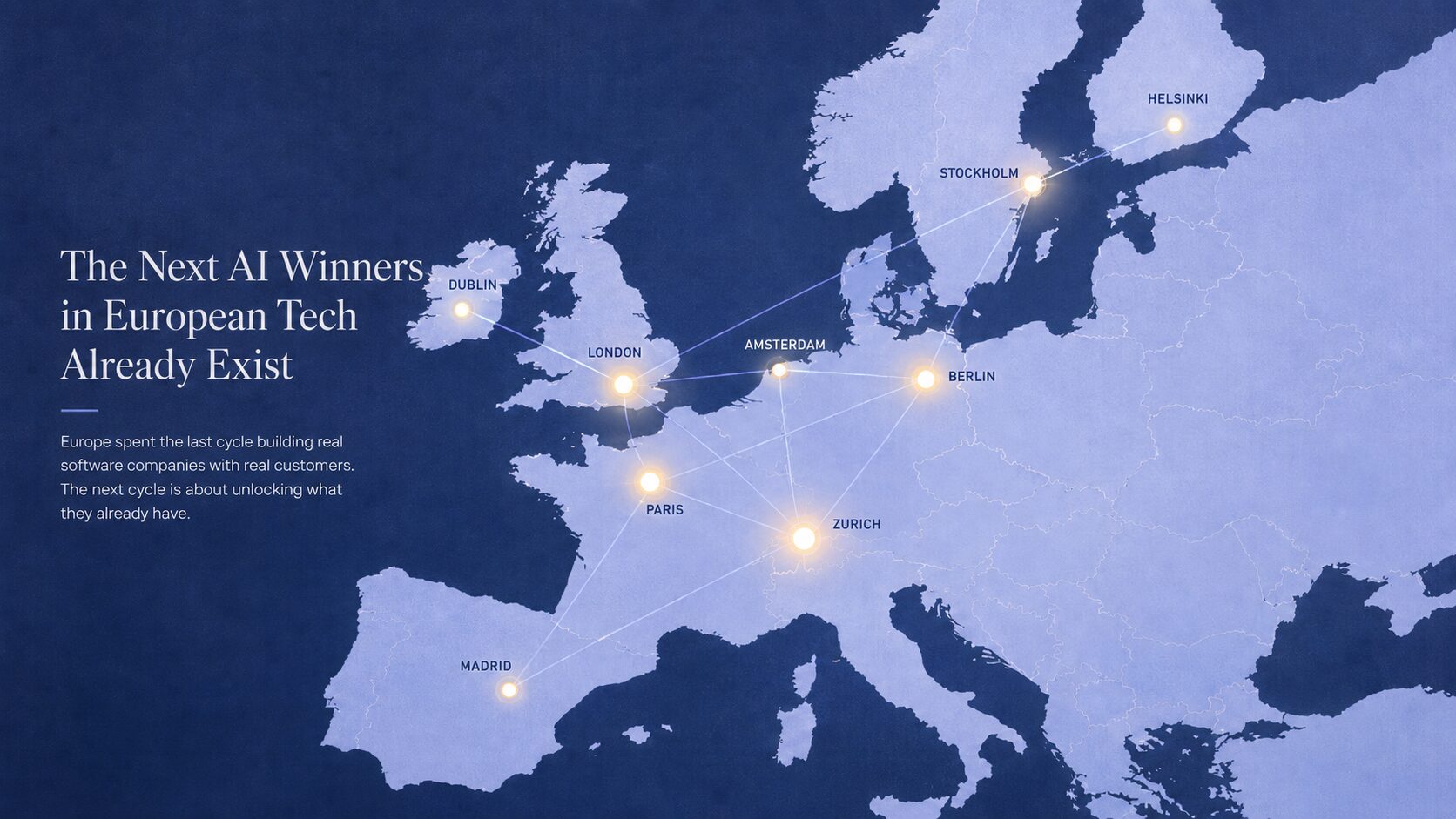
The Next AI Winners in European Tech Already Exist

By Rafael Karamanian
Founder and Managing Partner at Lendity
The dominant AI narrative in Europe today is the same one being told in San Francisco. A new generation of AI-native startups, built from a blank canvas with the right architecture from day one, will rebuild the software stack and eat the incumbents along the way. That story is partly right, and for genuinely greenfield categories it may even be entirely right. But for any business that already lives inside a real customer workflow, the logic is different from what the venture narrative suggests, and the advantage sits more with the incumbents than most people are willing to admit.
This matters because Europe spent the last cycle building a lot of those incumbents. Hundreds of B2B software companies were funded between 2018 and 2023, many of them now somewhere between break-even and modest growth, with real customers, real revenue, and real operational depth. They are not exciting. They do not show up on the trend reports. And they may be exactly the companies best positioned to capture the next wave of value creation.
The starting position matters more than the starting architecture
A new AI-native founder begins with a model, a wedge product, and the slow work of acquiring the first customers, learning the workflow from the outside, and earning the right to expand. An existing scaleup begins with customers who already pay for a workflow the company has understood from the inside for years, distribution that took millions of euros to build, data that is structured by actual usage rather than scraped or synthetic, and a brand that customers have learned to trust enough to keep their procurement teams from rotating it out every twelve months.
In a stable software cycle, those assets are useful but not decisive. In the AI cycle, they become decisive. The hardest part of applying AI inside a business is not the model. It is everything around the model. Access to the workflow, the right to deploy, the data to train and evaluate on, the integrations into the systems of record, the trust to make changes that affect real revenue, and the customer relationships to roll out gradually rather than as a science project. An existing company has all of that on day one. A new AI-native startup is going to spend the next three years acquiring it.
The economics work very differently when you already own the customer
AI applied to a customer base you do not yet have is essentially a customer acquisition story dressed in technical language, and the cost structure of that acquisition is no different from any other software company in the same category. AI applied to a customer base you already own is something else entirely. It compresses delivery cost on existing revenue, lifts margins on contracts that have already been signed, expands the product surface without proportional sales and marketing spend, automates internal operations that were already being budgeted for headcount, and opens new revenue lines that can be sold into the same buyer who is already in the procurement system.
The first version of AI is a venture story. The second version is a free cash flow story. European tech needs more free cash flow stories and fewer venture stories, and this cycle finally creates the conditions for that to happen at scale.

The AI-natives are revealing the gap themselves
The clearest evidence that this asymmetry is real comes from watching what the AI-native companies themselves are now doing to compensate for it. After two years of trying to sell new AI products into enterprise workflows, a lot of these companies are running into the same wall. Their solutions are technically impressive, the demos are convincing, and yet customers buy slowly, deploy slowly, and value the existing tooling more than the venture narrative assumed they would. This is the diffusion problem, and it is consuming a significant share of the cash these companies raised.
The responses are telling. Forward Deployed Engineers, which is essentially a rebranded onboarding and implementation team built into the product organization. Joint ventures with private equity firms that already own the customer relationships. Standing up adjacent consulting practices to handle the integration work the product cannot do on its own. Heavy customer success investments designed to walk buyers through workflows that the customers do not yet know how to change. Each of these is a creative response to a real problem, and each of them is, in effect, an attempt to buy the operational position that an existing scaleup already holds.
That should be obvious from the other direction too. If the AI-natives are spending venture dollars to acquire customer access, workflow knowledge, and implementation trust, then the companies that already have those things are sitting on assets the market is actively repricing. The asymmetry is not theoretical. It is being demonstrated in real time, by the companies that have the most reason to deny it.
Not every existing scaleup is positioned
for this
The companies that can move are the ones where the workflow is genuinely complex, the data is genuinely proprietary, the buyer is genuinely sticky, and the brand carries enough trust that a meaningful change to the product is treated as a welcome upgrade rather than a procurement risk. Plenty of B2B software companies have none of those properties. Many do. The honest assessment usually takes about a week of work with a founder and the operating team, and the answer is rarely ambiguous once the work is done.
The harder question is whether the company is structurally able to act on what it has. This is where the previous cycle catches up with the present one. Many of these companies are carrying cap tables, governance structures, and management dynamics built for a different macro environment, and these structures actively prevent the kind of speed the AI window requires. A diluted founder with no remaining economic upside will not lead an aggressive transformation. A board still focused on protecting old valuation marks will not approve the investment required to retool the product. An investor who has mentally moved on will not engage with a strategic reset.
I wrote about that structural side in more detail in a separate piece. The short version is that the cap table problem and the AI opportunity are the same problem viewed from two different angles, and they need to be solved together. Fixing the structure without the strategy leaves value on the table. Pursuing the strategy without fixing the structure makes execution impossible.
What this means in practice
For investors, the most overlooked AI investments may not be the new ones. They may be sitting inside portfolios that were funded three to six years ago, in companies currently considered "okay" or "stable" or "not really growing anymore". Some of those companies have the assets to become meaningfully more valuable over the next 36 months than they ever looked at the original underwriting. The work to unlock that value is real but bounded, and the return on it can be larger than the return on another new venture deal in a crowded category.
For founders, this should be motivating rather than threatening. The narrative that AI-native startups will outcompete you is true in some categories and overstated in others. If you have customers who pay you because you understand their workflow better than the alternatives, the AI cycle is yours to capture if you choose to capture it. The question is whether the structure around you gives you the mandate, the energy, and the upside to do it.
For boards, the framing has to shift. Treating AI as a cost-efficiency line item misses the entire point. The companies that will create real value with AI in this cycle are the ones that treat it as a strategic acceleration program, with the same seriousness, sequencing, and capital allocation that any major product expansion would receive.
The window is open right now
The asymmetry between incumbents and AI-natives is largest at the start of the cycle, when the workflows are still being defined, the standards have not yet hardened, and the buyers are still figuring out what they actually want from AI. That window does not stay open forever. The companies that move now, with the assets they already have, will be the ones that set the new baseline. The companies that wait will eventually face AI-native competitors who have spent two or three years catching up on exactly the things the incumbents already had.
The next AI winners in European tech may already exist. They were just not labelled that way the first time around.
I wrote about the structural side of this, and what investors and founders can do to unlock these companies, in a companion piece on cap table resets and founder incentives.
Build smarter. Scale faster. Give up less.
Join 400+ founders getting our monthly insights on capital and growth.
Learn more about Funding Strategies

The Headcount Control Tower: How to Scale Efficiently by Tying Hiring to Revenue
Tag: Funding Strategies

The Capital Stack: A Guide Not to Accidentally Selling Your Entire Company
Tag: Funding Strategies

SeedStrapping: Why Your Next Round Might Be Your Worst Decision
Tag: Funding Strategies