
Investors, It Is Time to Reset the Game.
Bring the Founder Back.
European tech has a founder incentive problem, and I'm having this conversation every week.

By Rafael Karamanian
Founder and Managing Partner at Lendity
A company raised a large round in the 2020-2023 era. The valuation was high, capital was abundant, and the round may have included preference stacks, structured instruments, aggressive terms, or investors who had strong conviction but limited understanding of the company's fundamentals. At the time, it made sense. The market rewarded speed, ambition, and capital absorption, and most checks were written and accepted in good faith. The rules of the game looked clear.
Then the market changed. Growth slowed, valuations compressed, follow-on capital became harder to secure, exit timelines extended, AI reshuffled the strategic agenda, and profitability became important again. The public market corrected the private market's imagination.
But many private cap tables still reflect a world that no longer exists.
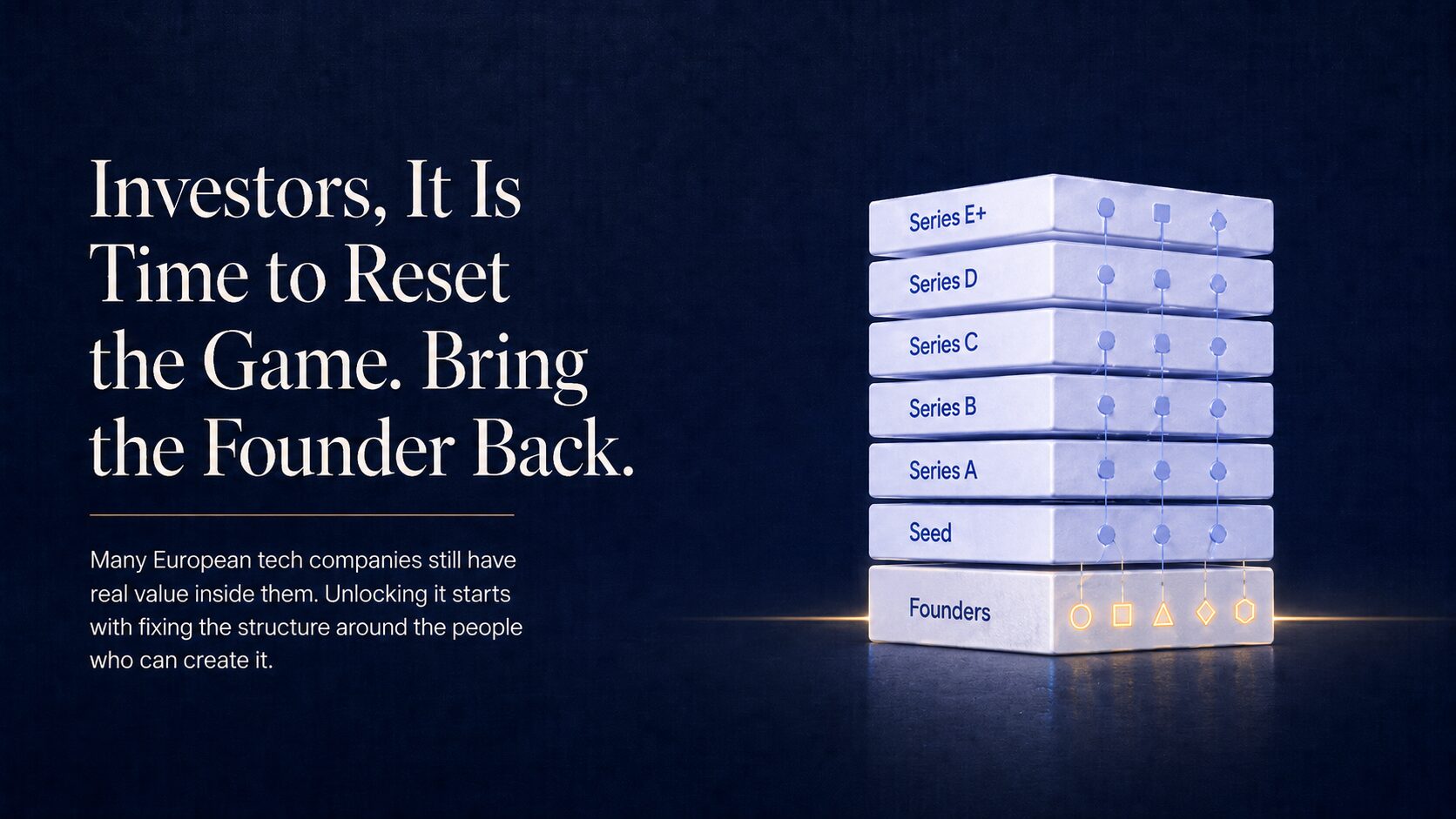
The result is a strange limbo across European tech. Many companies are still alive, with real customers, real revenue, real products, and real domain knowledge. Some are close to break-even, some are growing slowly, and some could still become valuable companies. Yet the people most capable of creating that value, usually the founders, often have little meaningful economic upside left. They are out of the money. Common shareholders sit below a preference stack that may consume most of the realistic proceeds, so the company may still have enterprise value while the founder's personal incentive has quietly disappeared.
We talk a lot about runway, about AI, about efficiency, about bridge rounds and insider rounds and secondary markets. We talk much less about stamina. And stamina is everything, because building a company for another five years requires more than responsibility. It requires belief, energy, and upside.
The hidden cost of a broken cap table
A broken cap table is easy to ignore because the company keeps operating. The team is still there, customers still pay, investors still receive updates, board meetings still happen, and the founder still shows up. From the outside, the machine appears functional. Inside, something has changed.
The founder is tired, the investors are tired, the board is often vague. Some investors have mentally moved on while others remain involved mainly as observers, and everyone hopes time will solve the problem. Time rarely solves a misaligned cap table, and it usually makes it worse. When the common shareholders have little realistic upside, the founder starts carrying the company out of duty rather than ambition. That may work for a few months. It rarely works for years.
This matters because the founder is often still the person best positioned to create the next wave of value. They know the customers. They know the product. They know the edge cases. They know the industry. They know where the bodies are buried. They have the trust, context, scar tissue, and pattern recognition that a new manager or outside investor will struggle to replicate.
This is especially true right now. The AI opportunity is extraordinary for existing companies, because they already have customers, workflows, data, distribution, brand, and trust. A new startup may move faster on a blank canvas, but an existing company can deploy AI directly into real processes and real customer relationships, and that is a huge advantage. But someone has to lead the expedition, and in 99% of cases the founder is still the right person to do it.
The problem is that many founders are being asked to climb the mountain again while their upside remains buried under old terms from a different market. That is not a setup for a five-year sprint.

Investors need to mark the cap table to reality
The old cap table may be legally valid, even technically defensible, but economically it often describes a market that no longer exists. If a company raised at a peak valuation with heavy preferences, and now operates in a lower-growth, lower-multiple environment, the preference stack becomes a ceiling on motivation rather than a protection on returns.
At that point, the question is simple: do investors want to preserve the old structure, or do they want to maximize the probability of future value creation? Those are very different objectives. Preserving the old structure feels emotionally easier because it avoids a difficult conversation, avoids acknowledging a markdown, avoids explaining to LPs that the 2021 price is gone, and buys time. But buying time without fixing incentives usually reduces the chance of a good outcome.
If the company can still create value, the rational move is to reincentivize the people who can create it. That means accepting reality, which may require marking down the investment, hurting fund metrics, making the next fundraise harder, or explaining to an investment committee why the old valuation was wrong. None of that is comfortable. The alternative is often worse: a founder with fading stamina, a board that delays, a cap table that blocks upside, and a company that slowly loses its best chance of reinvention.
The earlier this is addressed, the better the outcome for everyone, and especially for investors.
This is not a gift to founders
Resetting incentives should be framed correctly. It is not charity, not a free transfer of value, and not a reward for missing the original plan. It is a value-maximization exercise. If the founder is still the best person to create the next CHF 20 million, CHF 50 million, or CHF 100 million of enterprise value, then giving that founder meaningful upside is rational. The purpose is to make the economic game worth playing again.
The founder has responsibilities too. If there is still a realistic path to value creation, the founder should act with seriousness toward the people who backed the company. Investors took risk, employees committed time, customers trusted the product, and the founder has a duty to face the situation directly rather than drift through it.
But duty has limits. A founder's most valuable asset is time. If the company's upside has disappeared for the people doing the work, asking them to sacrifice another five years becomes unreasonable. They could build something new, join a better-positioned company, or move their energy to a different ship with a cleaner trajectory. Many stay because the company is their baby, some stay out of loyalty, some stay out of identity, and some stay because they have never paused long enough to ask whether the game still makes sense. That is exactly why this conversation needs to happen now.

There is no single solution
Every situation is different. The right structure depends on the company's current value, the liquidation preference stack, the investor base, governance, growth prospects, debt capacity, founder shareholding, team composition, and the realistic exit scenarios. But the toolkit is well known. Some companies need a management incentive plan, others need a full recapitalization, others need investors to waive, reset, or restructure liquidation preferences. Some need old or tired investors bought out at nominal value, some need a new holding structure, and most need a combination of instruments alongside clear governance and a refreshed strategic plan.
If the people who must create the value have little upside in the value they create, the structure is broken. Fix the structure.
The AI window makes this urgent
I would be much more patient about all of this if it were only a cleanup exercise, but it is more than that. We are in a rare window where existing tech companies can transform themselves faster than the market expects, because they already have what new AI-native startups often lack: customer access, workflow knowledge, historical data, distribution, trust, brand, industry context, existing revenue, and operational infrastructure.
That means the next phase of value creation may come from companies that already exist, if they move with enough urgency. But this requires leadership: founders who are fully back in the game, investors willing to make difficult decisions early, and boards that move beyond passive observation and into active alignment. The opportunity is too good to waste on cap table inertia.
My message to investors
If you have a portfolio company in this situation, do not wait. Look at the cap table honestly, look at the realistic exit scenarios, look at the preference stack, and look at who is actually creating value today. Then ask whether those people are properly incentivized. If the answer is unclear, it is probably already a problem.
Have the difficult conversation. You invested in good faith, the market changed, and the responsible thing now is to adapt the structure so the company has the highest chance of creating value from here. That may mean accepting a markdown, giving up a preference that only exists on paper, or letting new economics emerge around the people who can still build. A smaller claim on a company with renewed energy is often worth far more than a larger claim on a company that slowly loses its founder, its urgency, and its chance to transform.

My message to founders
If you are in this limbo, you are allowed to say it out loud. You can feel a moral obligation to your investors and still ask whether the current structure gives you a fair reason to keep building. You can care deeply about the company and still acknowledge that your time has value. You can be loyal and still be direct.
Go have the conversation. Show the scenarios, show the preference stack, show what the company can become if the incentives are fixed, and show what happens if they are left untouched. Then get back to building.
If the structure is fixed, and the company still has customers, product, trust, and a real path forward, this may be one of the best moments in years to create value. The companies that move now can use AI to accelerate, the founders who regain upside can regain energy, and the investors who face reality early can still capture meaningful value. The window will not stay open forever.
Fix the cap table. Bring the founder back into the game. Then go build.
The strategic side of this same problem, and why existing European tech companies may be the natural winners of the current AI cycle, sits in a companion piece on AI and existing scaleups.
Build smarter. Scale faster. Give up less.
Join 400+ founders getting our monthly insights on capital and growth.
Learn more about Funding Strategies

The Headcount Control Tower: How to Scale Efficiently by Tying Hiring to Revenue
Tag: Funding Strategies

The Capital Stack: A Guide Not to Accidentally Selling Your Entire Company
Tag: Funding Strategies

SeedStrapping: Why Your Next Round Might Be Your Worst Decision
Tag: Funding Strategies