
Switzerland’s AI Wedge
What I took away from the Builders & Backers Table dinner in Zurich

By Rafael Karamanian
Founder and Managing Partner at Lendity
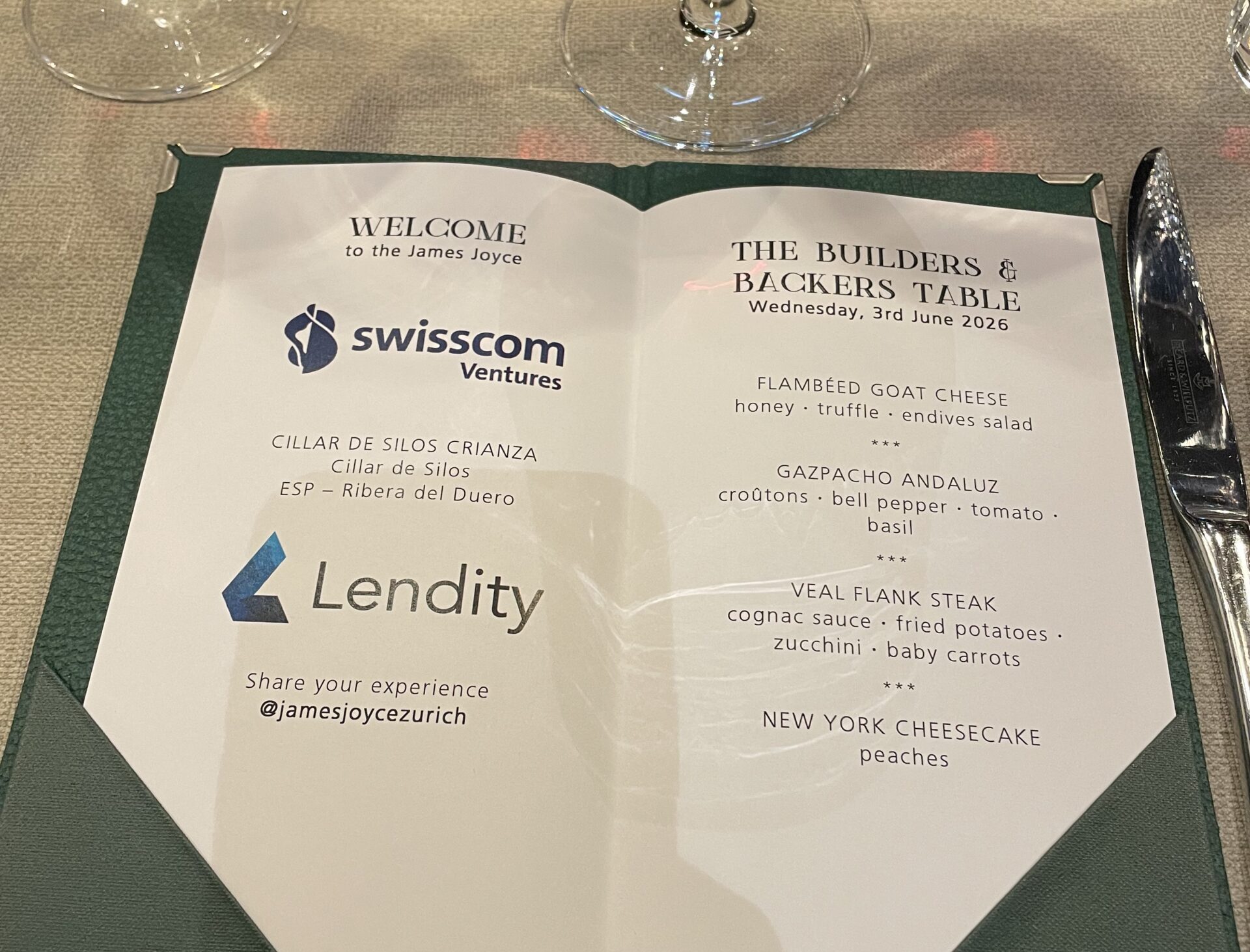
Last week I hosted another edition of the Builders & Backers Table in Zurich, one of those Lendity dinners that started as a simple idea and has slowly become one of the most valuable things I do, because it gives me a very direct read on what founders, investors and operators are actually thinking about when there is no stage, no panel, no pitch and no need to sound cool.
The format is intentionally simple. One table, a curated group of people, a few topics to get the conversation started (wine helps!), and then enough space for the discussion to go wherever it needs to go. I always prepare a few anchors because I think it helps people arrive with the right mindset, but the best part is usually when the conversation moves away from the original structure and into the topics that people really care about.
This time, Swisscom Ventures joined as co-host after attending a previous edition, and together with Klea Wenger we framed the evening around two topics that felt very relevant given where the market is right now. The first was privacy, data sharing and strategic control in the age of AI. The second was the role that Switzerland and Europe can realistically play in the broader AI race, especially when the US and China are putting so much money, talent and compute behind frontier models.
Around the table we had a great mix of builders and backers. There were institutional investors, founders building in robotics, AI, infrastructure, software, industrial inspection, energy and ocean monitoring, as well as people with direct experience at OpenAI, Meta and Google, including someone who helped open OpenAI’s Zurich office. That combination made the conversation very practical, with people who are building, funding, using, selling and sometimes struggling with these technologies in real time.
AI Privacy is becoming an operating question
One of the first topics that stayed with me was the strange way we think about privacy. As individuals, many of us have become very sensitive about how we share our personal data, whether that means cookies, location tracking, photos, contacts or health data. We complain when apps ask for too many permissions and we have become quite aware that data has value, but inside companies, the discipline is much less consistent.
Founders have limited runway, even when they are well funded. Teams are under pressure. Tools are becoming better every month, and some of them feel almost subsidized when you compare the value they create with the price you pay. If a model helps you save hours, reduce cost, write better, code faster, analyze more data or support customers more efficiently, it is very hard to ignore it because of a future dependency risk that is still hard to quantify.
Still, I think this question will become more important over time. The more sensitive the workflow, the more companies will need to ask themselves who controls the model, where the data goes, what gets stored, who can access it, what happens to logs, what happens if pricing changes, what happens when a critical part of the company’s knowledge starts depending on someone else’s infrastructure.
In the end, every LLM provider has its own agenda, investors, incentives and strategic priorities.
For generic work, many external models will be perfectly fine. For core workflows, regulated workflows, strategic workflows or workflows that touch real competitive advantage, the bar should probably be much higher.
Runway is runway, but dependency is dependency
This was one of the more practical tensions in the conversation, because everyone understands the long-term risk of depending too much on a few centralized AI providers, but everyone also understands the very immediate reality of startup life.
You can tell a founder to be careful with data, infrastructure and dependency, and that founder may agree with you completely, but then they also have a team to run, customers to serve, a product roadmap to ship and a bank account that goes down every month. When a tool gives them leverage today, the theoretical risk of being locked in tomorrow may not be enough to stop them from using it.
That tension will not disappear, and I actually think it will define a lot of AI adoption in the next few years. Companies will need to make trade-offs, using external models where speed matters more than control, local or private deployments where control matters more than convenience, and hybrid setups where the sensitivity of the workflow decides the architecture.
The companies that get this right will probably be the ones that do not treat AI policy as a legal document sitting in a folder, but as a real operating question. What can we upload? What should never leave our environment? Which workflows are strategic? Which workflows are just productivity tools? Where are we comfortable using subsidized infrastructure, and where would that create a long-term risk that is too high?
These are not theoretical questions anymore. They are becoming day-to-day operating decisions.

Switzerland should be ambitious, but focused
The second big topic was Switzerland’s role in AI, and this is where the conversation naturally moved into the broader question of Europe, the US and China.
The US and China are spending at a scale that Switzerland and Europe cannot really match. The frontier model race needs enormous capital, massive compute, access to chips and memory, very scarce talent and the willingness to burn money for a long period of time. The US has deep capital markets, a huge domestic market, one main language, one currency, a strong technology ecosystem and the reserve currency of the world, while China has its own form of scale, coordination and strategic ambition.
Europe was built on a different foundation, with a different history and a different promise, and I think we sometimes forget how much it actually delivered. Peace, stability, cooperation and the ability to bring many different countries into one broader project is a huge achievement. Airbus is a good reminder that Europe can build category-defining companies when the mission, structure and ambition come together in the right way.
But on frontier models, I think we need to be honest. Europe is late, and every month matters. The gap becomes harder to close when other players are spending more, hiring faster, securing more compute and attracting more of the scarce people who can actually push the frontier.
There are always contrarian cases where smaller, focused, resource-constrained teams outperform larger players, and Switzerland has exceptional talent, strong universities and a deep engineering culture, so I would never dismiss that completely. But as a base case, I do not think Switzerland’s best opportunity is to outspend the US or China in general purpose frontier models.
The more interesting question is where Switzerland has a natural space to win, and my answer after the dinner is even stronger than before.
Trust, reliability and vertical depth may be the real Swiss AI opportunity
Switzerland should focus on the areas where trust, security, reliability, precision, governance and vertical depth matter so much that customers will not simply hand over their most important workflows to whichever model is cheapest or most convenient this month.
Think about pharma, banking, fintech, insurance, manufacturing, robotics, energy, healthcare, industrial inspection and critical infrastructure. These are not casual AI use cases where a slightly better chatbot is enough. These are areas where mistakes are expensive, liability matters, data matters, regulation matters, uptime matters and customers care deeply about who controls the intelligence layer.
If the model, the data feedback loop and the decision layer all sit somewhere else, the company using the tool may still own the customer relationship on paper, but over time it can become dependent on infrastructure, incentives and governance that it does not control.
That is why the word sovereignty keeps coming back, even if it sometimes sounds too political or too abstract. In practice, sovereignty is very concrete. It is about whether a bank can run AI on sensitive client information without creating unacceptable risk. It is about whether a pharma company can use AI in research, quality control or compliance without leaking valuable data. It is about whether a robotics company can deploy agents in industrial environments where latency, reliability and safety matter. It is about whether a manufacturer can trust an AI system inside a production workflow.
It is also about whether a founder can build long-term customer trust while depending on infrastructure that may change direction for reasons completely outside their control.
Robotics made the discussion much more concrete
The robotics founders at the table made this especially tangible, because AI is moving very quickly from screens into the physical world, into machines, sensors, industrial assets, energy sites, dangerous inspection areas and oceans.
In that world, the hardware often becomes the wedge into the customer, the workflow and the environment. Once the hardware is deployed, it starts generating proprietary data, and that data can become the basis for intelligence, monitoring, prediction, automation and eventually recurring software or service revenues.
That is a very important business model point. A company may start by selling a physical product, but the long-term value may sit in the software layer that learns from the physical deployment. The hardware opens the door into the customer environment, the data accumulates through real usage, the models improve as the company understands more edge cases, and the customer gets more value as the workflow becomes more embedded in daily operations.
Over time, what started as a hardware sale can become a much more attractive recurring revenue relationship. For me, this is one of the reasons I remain very positive about software, even if everyone is now debating whether AI will eat large parts of it.
Software will change, pricing will change, interfaces will change, teams will change, but software as the intelligence and coordination layer of companies is becoming more important. The best software companies may look more vertical, more operational, more services-heavy, more outcome-based and more deeply connected to physical processes, but the need for software itself is not going away.

Europe’s friction can also be a source of opportunity
We also spent time on the usual Europe and Switzerland friction topic, because anyone building from here feels it very quickly. Different languages, different markets, different regulations, smaller domestic markets, slower procurement, less aggressive capital markets and more red tape are real constraints.
Switzerland is an amazing place to build from in many ways, but it is also a small market, so international expansion becomes relevant very early, and that creates complexity when the company is still young.
At the same time, I increasingly think these frictions are part of the opportunity. In a perfectly efficient market, obvious opportunities get captured very quickly. Capital comes in, talent follows, competition increases, distribution gets expensive and margins compress. In Europe, the friction reduces the number of people willing to go after certain problems, which creates space for founders who are persistent enough, local enough and knowledgeable enough to navigate the mess.
Some opportunities survive here longer precisely because they are annoying, fragmented or operationally complex. I know this can sound like making excuses for Europe, but I actually think it is quite practical.
If you are building from Switzerland or Europe, the answer cannot always be to complain that the market is not the US. It is not the US, and it will not become the US anytime soon. The better question is how to build companies that take advantage of the market we actually have, with its trust, talent, stability, purchasing power, technical depth and regulatory complexity, while accepting that the playbook needs to be different.
One comment around the table was that Europe may need a Milei-style or DOGE-style shock to cut bureaucracy and force more efficiency. I understand the frustration behind that comment, especially coming from Argentina, but given how the EU is constructed, with national interests, political trade-offs and veto power across countries, I do not see a radical simplification happening quickly.
So I prefer to focus on what can be done by founders, investors and companies despite the system, while still pushing for more ambition and less unnecessary friction wherever possible.
AI can create prosperity, but the transition will be messy
We also touched on the labor market and the broader social impact of AI, and I think this is where the conversation becomes more uncomfortable.
I am long-term positive about AI because I believe it can unlock better science, better companies, better services and hopefully a better quality of life. But the transition will not be smooth for everyone. Some sectors are already feeling the effect, and much of the displacement may happen quietly under the surface through slower hiring, fewer junior roles, more automation of tasks, more pressure on wages and higher expectations for what each person can produce.
This is especially hard for people later in their careers. If someone is in their 50s and their role gets heavily automated, reskilling and reinserting into the labor market is much harder than people in tech sometimes admit. Society will still need labor, and over time new roles will appear, but the path from one world to the next can be very volatile for the people living through it.
You can already see small versions of this everywhere. At Migros HB in Zurich, for example, many people now pay at self-checkout while cashiers stand nearby watching the process. That does not mean all work disappears, but it shows how tasks shift before the big employment statistics fully capture what is happening.
There is also a bigger question about whether AI will actually give people more time. We have seen this movie before. Email made communication easier and then everyone had more emails. Zoom made meetings easier and then everyone had more meetings. AI could easily create the same problem if companies simply use it to increase output expectations without redesigning how work happens.
The productivity gains will only translate into a better quality of life if organizations rethink workflows, incentives, team structures and decision-making. Otherwise, we may just end up with more content, more analysis, more messages, more meetings and the same feeling that everyone is constantly behind (we are all starting to get that feeling).
The bottleneck has moved from access to judgment
For founders, the biggest takeaway is that the bottleneck has moved. Access to powerful models is increasingly available, and while compute is still important and can still become a constraint in some cases, for many entrepreneurs the real question is no longer whether they can access AI capabilities. The real question is where and how they should deploy them.
Which workflow is painful enough? Which customer problem is valuable enough? Which vertical has enough urgency? Which edge cases matter? Which data is proprietary? Which distribution channel gives you an advantage? Which trust requirements make the solution hard for a generic player to copy?
This is why I am so positive about founders who have been deep in their industries for years before AI became the hype. The founder who has spent years selling into hospitals, factories, banks, logistics companies or energy providers may now have an enormous advantage because they understand the workflow, the buyer, the constraints, the objections, the weird edge cases and the economic pain.
The same is true for product teams, engineers, sales teams and operators who have been close to customers for a long time. AI gives them new leverage, but the vertical understanding is what tells them where that leverage actually matters.
That, for me, is the Swiss opportunity. Switzerland has a strong reputation in industries where trust, precision, resilience and quality matter, and it has a deep base of people who understand complex verticals from the inside. If AI moves into the real operating layers of pharma, banking, fintech, insurance, robotics, manufacturing, energy and healthcare, then the winners may be the teams that combine modern AI capabilities with years of boring, specific, hard-earned domain knowledge.
If AI keeps moving from tool to agent, and eventually from productivity layer to something closer to an independent intelligence layer, then the question for companies becomes much deeper than “which model should we use?” It becomes: where do we want intelligence to live inside the company, what should it be allowed to see, which decisions should it influence, and which parts of the customer relationship, data loop and operating knowledge are too strategic to outsource blindly.
Those are exactly the types of companies I want to spend more time with. Teams that treat intelligence, trust and judgment as deliberate operating design choices.
Staying close to the mud
This is also why I value the Builders & Backers Table so much. It keeps me close to the messy version of reality, where founders are deciding what to build, investors are deciding what to back, companies are deciding what risks to take, and everyone is trying to understand how quickly the ground is moving under their feet.
My conclusion after this edition is that Switzerland should be ambitious, but also focused. We probably should not measure ourselves only by whether we can produce the next general-purpose frontier model. There are other ways to build very important companies, especially in the parts of AI where customers need trust, security, reliability, sovereignty, vertical depth and long-term resilience.
Those areas may look less flashy than the frontier model race, but they may end up producing some of the most durable value.
What a time to be building and investing in Switzerland!
The Builders & Backers Table is a private dinner series hosted by Lendity, bringing together founders, investors, and operators for honest conversations about what is actually happening in tech and finance.
Build smarter. Scale faster. Give up less.
Join 400+ founders getting our monthly insights on capital and growth.